How to hit and hold any temperature using two vents — and what to do when the grill has gotten too hot.
Controlling kamado temperature comes down to this: dose the air, not the charcoal. The bottom vent handles the coarse adjustment, the top one the fine one, and you always approach your target temperature from below — closing the vents about 20°C (35°F) before the target, since the ceramic keeps climbing a little further on its own.
Temperature control is the one thing you actually need to learn on a kamado. It isn’t difficult — but it works differently from any other grill, and the most common beginner mistake costs you an hour.
The Principle: Air, Not Charcoal
You control temperature through the amount of air, not the amount of charcoal. More air means more heat. The bottom vent controls intake coarsely, the top one controls exhaust finely. Go ahead and fill the firebox — excess charcoal doesn’t burn as long as you don’t give it air.
Controlling Kamado Temperature: Reference Points
- 110–130°C (230–265°F) — smoking and low & slow. Bottom vent a finger’s width, top vent nearly closed.
- 150–180°C (300–355°F) — roasting and whole poultry. Both vents about a quarter open.
- 200–250°C (390–480°F) — baking and indirect cooking. Both vents about half open.
- 280–350°C (535–660°F) — steaks and pizza. Both vents wide to fully open.
The Most Important Rule: Approach From Below
Always approach your target temperature from below and stop short of it — about 20°C (35°F) under. The ceramic is slow to respond and keeps climbing afterward. Anyone who waits until the thermometer shows the target before closing the vents regularly ends up 50°C (90°F) too hot.
When the Grill Has Gotten Too Hot
This is the moment that calls for patience. Close both vents most of the way — not all the way, or you’ll smother the fire entirely — and wait. It takes 20 to 30 minutes for the ceramic to release its stored heat. Don’t open the lid to speed things up: the rush of air does exactly the opposite.
Controlling Kamado Temperature in Two Zones
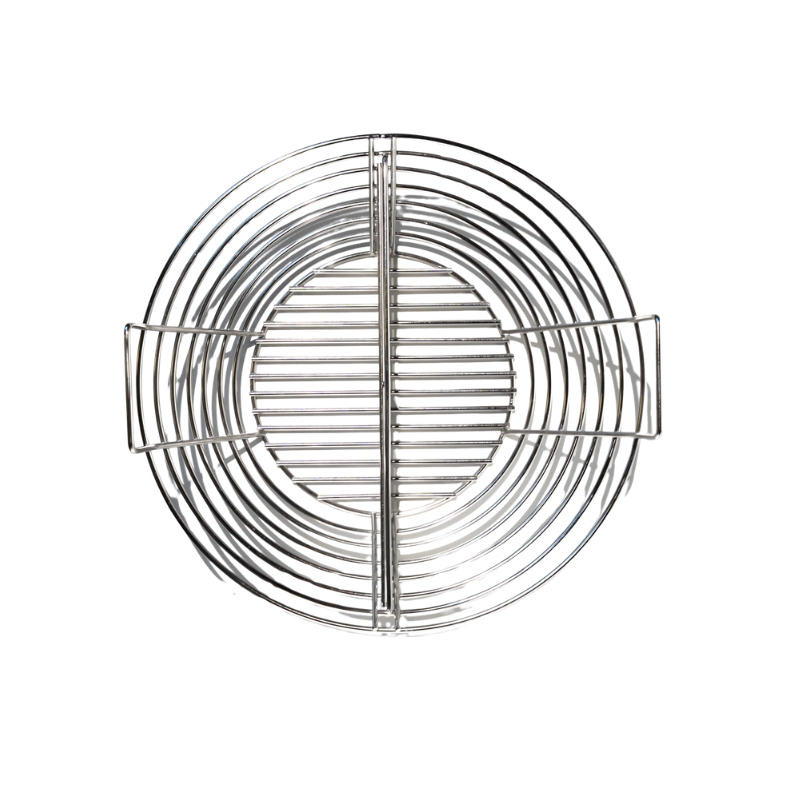
With the heat deflectors, you split the cooking space in two: direct coals on one side, indirect heat on the other. That lets you finish braising one piece while searing the next over direct heat. The two-zone system comes standard with the Evolve Ultra Series.
What Makes Control Easier
A charcoal basket keeps the coals together and the airway clear — both make temperature more predictable. And then there’s ash: if it blocks the lower vent, you lose control over your air supply without understanding why. That’s the most common reason a kamado suddenly “won’t get hot anymore.”
After Grilling
Close both vents. The coals go out on their own, and you can reuse what’s left next time. Let the grill cool down completely before putting the rain cover on.
Controlling Kamado Temperature: The Three Most Common Mistakes
Most temperature problems don’t have a mysterious cause. First on the list is ash blocking the lower vent: the grill can’t get air and won’t reach temperature, even with plenty of charcoal in the basket. Second is a leaky gasket — the vents stop having any effect because air is getting in somewhere else. Third is impatience: closing the vents too late, overshooting by 50°C (90°F), then waiting around for half an hour.
Keep these three things in mind and you don’t need any electronics. A kamado is a purely mechanical system of intake and exhaust, and that’s exactly why it’s so predictable once you understand it.
For how combustion and air supply relate to each other physically, see the Wikipedia article on combustion.
Frequently Asked Questions About Temperature
Why does the temperature drop when I put meat on?
Because cold food absorbs energy and the open lid releases heat. A dip of 20–30°C (35–55°F) is normal; the ceramic recovers it within a few minutes as long as you leave the vents where they were.
Can I hold the temperature overnight?
Yes. At 110°C (230°F), a well-filled firebox carries for twelve hours or more. The key is letting the grill run stable for at least an hour before you go to bed — whatever’s been steady up to that point usually stays that way.