
Every ceramic grill is sold as a smoker. The specifications that actually decide whether it is a good one are less often discussed, so here they are in order of importance.
1. Wall thickness
This is the whole argument for ceramic. A thick wall stores heat and radiates it back inward, which is why a kamado holds 110 °C for hours without being touched. A thin ceramic body behaves much more like steel — it loses heat, the fire works harder, and the temperature wanders.
If you compare two grills on one specification, compare this one.
2. The gasket
A kamado controls temperature by restricting air. If the dome does not seal, the vents stop being a control — air leaks in around the rim, and the grill runs hotter than you asked regardless of how far you close things down.
Look for a fibreglass gasket, and check what a replacement costs. It is a wear part on every brand, and it is the component most likely to need attention within a few years.
3. Charcoal capacity
An overnight cook on one load is the difference between smoking being pleasant and smoking being a chore. A firebox that needs refuelling at hour six means opening the grill and losing heat exactly when the cook is most delicate.
Bigger bodies help here, but so does a charcoal basket that lets you fill the space properly rather than piling fuel loosely.
4. Vent precision
Low and slow lives in a narrow band of airflow. The top vent needs to adjust in small, repeatable increments — a vent that jumps from 110 to 150 °C between two settings makes precise control guesswork.
5. Deflector arrangement
Smoking is indirect, so something has to sit between the fire and the food. How easily that goes in and out, and how much cooking space it costs, shapes how often you actually smoke rather than just grill.
What matters less than the marketing suggests
Maximum temperature. Every ceramic grill will exceed what smoking needs by 200 °C or more; a higher ceiling tells you nothing about performance at 110 °C.
Brand history, too. The physics is the same across every well-built ceramic grill — thick wall, good seal, controllable air. A grill that gets those three right will smoke as well as one costing considerably more.
Where Evolve sits
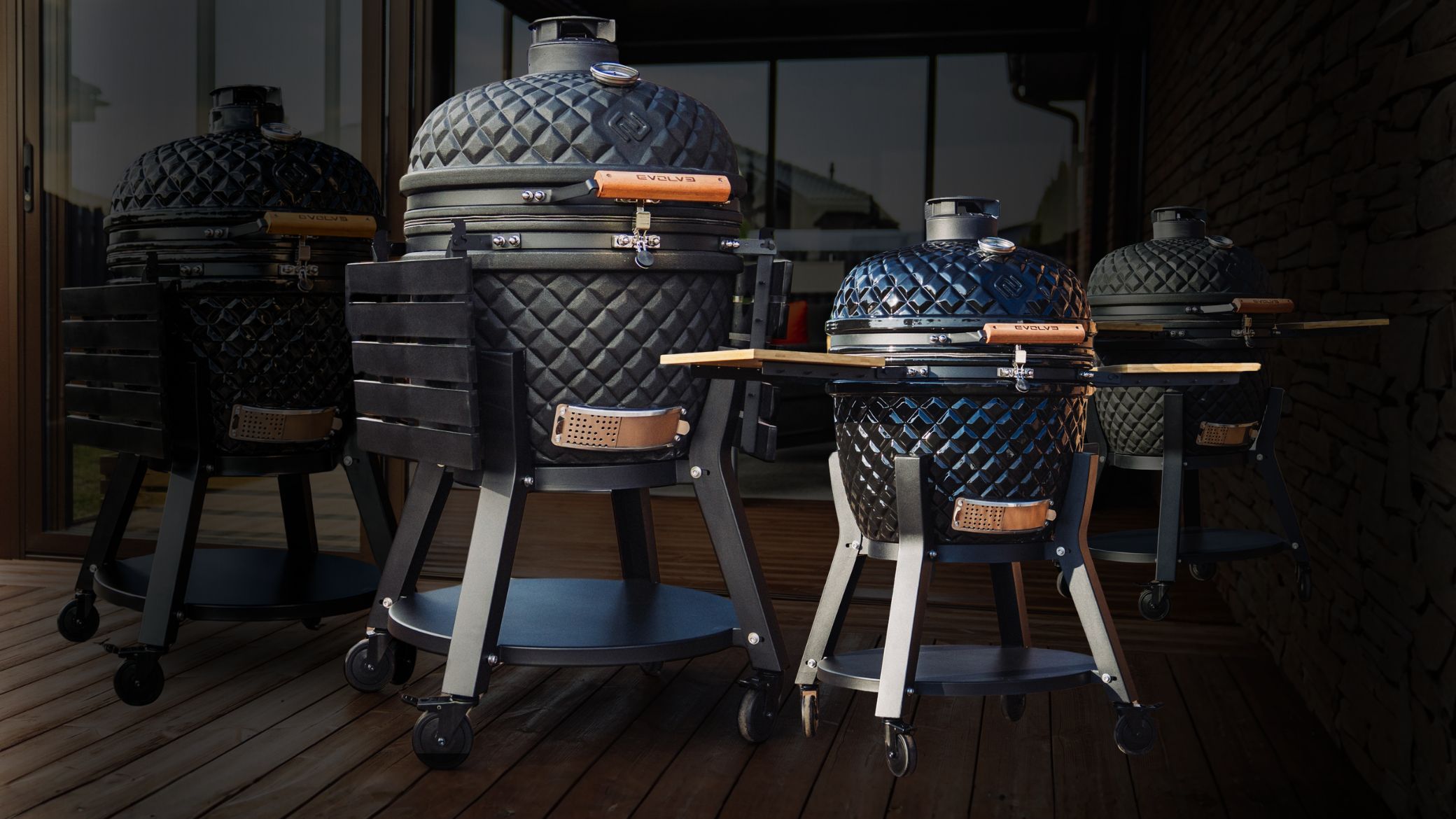
Thick ceramic base and dome with a limited lifetime warranty on both, a fibreglass gasket, a two-zone system, and a 51 cm grate at roughly 2,040 cm² — enough for two racks of ribs flat with a deflector in place.
If you want to see what the format does before buying, our low and slow guide covers a full cook, and ribs is the best place to start. The range is here.
Frequently asked questions
Is a kamado a good smoker?
It is one of the best formats for it. Holding 110 °C for hours is the hard part of smoking, and a ceramic body does that largely by itself because the walls store the heat rather than losing it.
What temperature is low and slow?
Between 110 and 130 °C. Low enough for collagen to break down slowly, high enough to keep rendering moving. A kamado will hold that band on one basket of charcoal for most of a day.
Do I need a separate smoker?
Not if you have a ceramic grill. A dedicated offset smoker gives more capacity and a different smoke profile, but a kamado does the same job with far less fuel and attention.
Wood chips or chunks?
Chunks, buried in the charcoal. Chips burn out in minutes; chunks release smoke gradually across the cook, which is what a long smoke needs.