
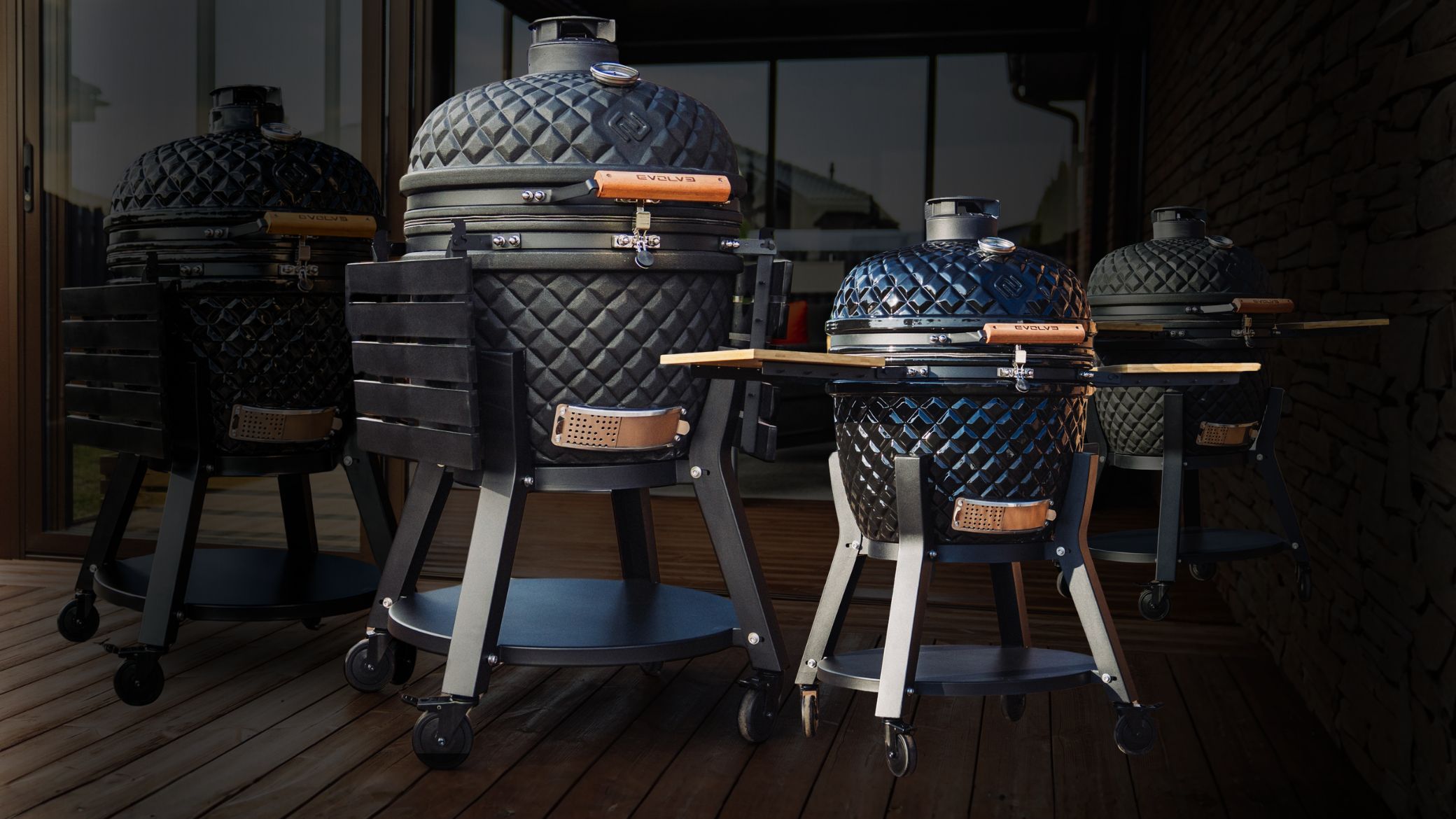
Both burn charcoal. Both cook over fire. The difference is the wall between the fire and the outside air, and it changes more than it sounds like it should.
Where the heat goes
A steel kettle has a thin skin. Heat produced by the charcoal radiates straight through it, so the fire has to keep working to maintain the temperature inside. Open the lid and a large part of that heat leaves with it.
Ceramic absorbs instead. The wall soaks up heat as the grill comes up to temperature and then radiates it back inward. After half an hour the body itself is the heat source, and the charcoal is topping it up rather than doing all the work.
What that changes in practice
Fuel. A ceramic kamado will run a long low cook on a fraction of the charcoal a kettle needs for the same job, because it is not constantly replacing heat lost through the wall.
Stability. This is the real difference. On a kettle, holding 110 °C for six hours means watching vents, adding fuel and fighting the weather. A kamado at 110 °C mostly holds itself — set the vents, close the lid, and check in occasionally.
Recovery. Open a kettle and the temperature drops and takes minutes to come back. Open a kamado and the stored heat in the walls brings it back almost immediately, which matters when you are turning several things.
Moisture. A sealed ceramic body loses far less moisture than a vented steel one, so long cooks come out succulent rather than dried at the edges.
Where the kettle wins
Three things, and they are not trivial.
Price: a good kettle is a fraction of what a ceramic grill costs. Weight: a kamado is around 96 kg and is not going to the beach. And speed: a kettle is at temperature sooner, because there is no thermal mass to bring up first.
If you grill a handful of times a year and have no interest in smoking, the honest recommendation is a kettle. You will not get your money back from ceramic.
Where the kamado wins
Range, mostly. The same grill that sears at 300 °C will hold 110 °C for a brisket and 350 °C under a pizza stone. A kettle does the first well, the second with effort, and the third not at all.
The other is unattended time. If the appeal of barbecue for you is putting something on in the morning and eating it in the evening, a ceramic grill is built for that and a kettle is not.
If you are weighing a kamado against something else entirely, our ceramic grill versus gas comparison covers the other common alternative, and the buying guide covers what to check before you buy either. The Evolve ceramic range starts at EUR 749.
Frequently asked questions
Is a kamado not just a charcoal grill?
It is one, but the ceramic body changes how it behaves. A steel kettle loses heat through its wall and needs the fire to replace it; ceramic stores the heat and gives it back, which is why fuel use and temperature stability are so different.
Does a kamado really use less charcoal?
Substantially less on long cooks, because less heat escapes. On a quick 20-minute sear the difference is small — it is the multi-hour cooks where the gap becomes obvious.
Can a kettle grill smoke?
It can, with a two-zone fire and patience, but holding 110 °C for six hours in a thin steel barbecue means constant vent adjustment and refuelling. A ceramic grill will sit there on its own.
Is a kettle grill better for anything?
Price, weight and speed. A kettle costs a fraction as much, you can carry it, and it is ready sooner. If you grill occasionally and never smoke, it is the sensible buy.