Steak on a ceramic grill is where the thermal mass earns its keep — and also where people most often end up with a burnt outside and a cold middle. Both outcomes come from the same setting.
The number
Aim for 280 to 320 °C at the grate for searing. That is hot enough to build a crust quickly, and not so hot that the surface carbonises before the interior has moved.
The dome thermometer reads the air, not the grate, and directly over the coals the grate runs hotter than the dome suggests. Treat the dome reading as a guide and the behaviour of the meat as the truth.
Why two zones matter more than the number
A two-zone fire — charcoal banked to one side, the other side clear — is what makes steak controllable. The hot side builds the crust; the cool side finishes the interior without adding more colour.
Without it you have one setting, and thick steaks become a race between the crust and the centre that the crust always wins.
A charcoal basket makes this much easier to hold, because the fuel stays where you put it instead of spreading across the bowl over the cook.
Thick steaks: reverse sear
For anything over about 4 cm, do it in two stages.
Bring the grill to 120 to 140 °C and cook the steak indirectly until the centre is roughly 10 °C below your target. Then take the steak off, open the vents, let the grill climb to searing temperature, and put it back over the coals for a minute or two per side.
The result is an even interior edge to edge with a hard crust — much harder to achieve searing first, because the residual heat keeps cooking the middle while you wait.
Thin steaks: straight on
Under about 3 cm, get the grill hot and sear directly. There is not enough thickness for a two-stage approach to help, and the extra handling only loses heat.
Get the grate properly hot before the meat lands — 15 to 20 minutes at temperature, not two. A hot grill with a cold grate gives you steam marks rather than a sear.
The accessory that actually changes this
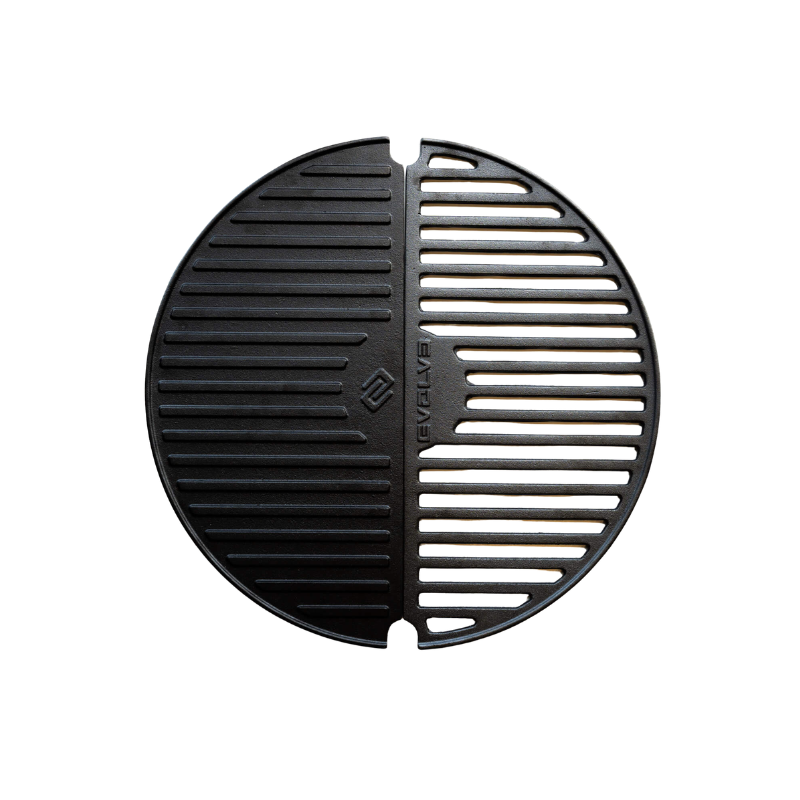
Cast iron. A thin stainless grate gives up its heat the moment cold meat touches it and takes time to recover; cast iron holds enough to carry on searing through the contact. It is the difference between defined bars and pale stripes.
Cast iron grates are the accessory most worth having if you cook steak often, and they come as standard in the Chef Combo. For the other end of the range, low and slow cooking uses the same grill very differently.
Frequently asked questions
What temperature should a kamado be for steak?
Around 280 to 320 °C at the grate for the sear. Hotter than that and the outside chars before a thick steak has warmed through; cooler and you get grey bands instead of a crust.
Do I need cast iron grates for steak?
Not strictly, but they make a visible difference. Cast iron holds far more heat than thin steel, so the bars stay hot when cold meat lands and leave a defined sear rather than pale marks.
Should I sear first or finish on high heat?
For steaks over about 4 cm, reverse sear — bring it up gently in the cool zone, then sear hard at the end. For thinner steaks, sear straight away; there is not enough thickness to justify two stages.
How do I stop a kamado overshooting for steak?
Start closing the vents 30 to 40 °C below your target. Ceramic keeps climbing after you restrict the air, so aim low and let it coast up.